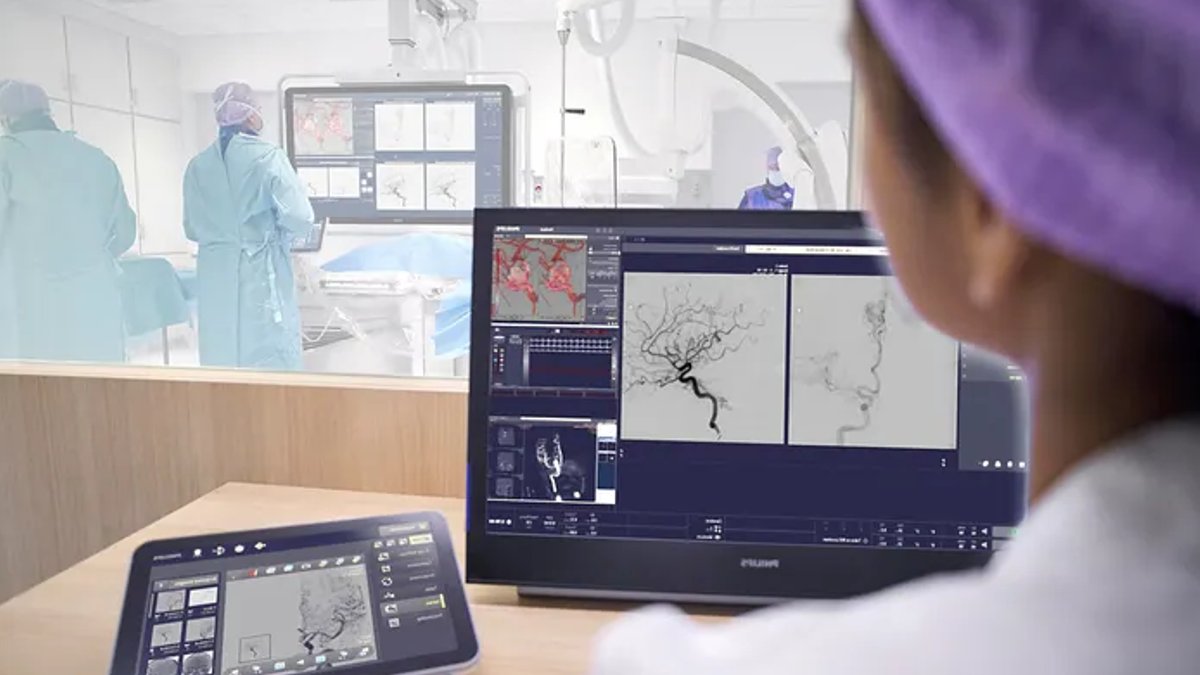
Philips is investing $33.7 million to develop a robotic system capable of performing mechanical thrombectomies autonomously. The medtech company announced on Wednesday that the project builds on its Azurion image-guided therapy platform. Philips will work with academic collaborators to integrate this existing infrastructure with steerable catheters and imitation-learning algorithms. The Azurion platform, which is already used in various medical procedures, provides a solid foundation for the development of autonomous robotic systems. By leveraging the platform’s capabilities, Philips aims to create a more efficient and precise system for performing mechanical thrombectomies.
This initiative is part of a broader program by the Advanced Research Projects Agency for Health (ARPA-H), an agency within the Department of Health and Human Services. ARPA-H is providing up to $175.3 million to fund the development of microbots and endovascular robots. Philips and Siemens Healthineers are two of the companies involved in the endovascular robotics project. The goal is to create autonomous systems that can perform procedures, which could improve access to timely stroke care. The involvement of multiple companies and academic institutions in this project highlights the complexity and interdisciplinary nature of developing autonomous robotic systems for medical applications.
A team at Johns Hopkins University is developing an autonomous device navigation system, while researchers at Boston University are working on the steerable catheters. J. Mocco, chair of neurological surgery at Weill Cornell Medicine, is also involved in the project. In a statement, Mocco noted that robotics has the potential to improve precision and accuracy in endovascular stroke care, while also extending specialist expertise through remote procedures. The development of steerable catheters is a key aspect of this project, as they will enable the robotic system to handle complex blood vessels and reach the affected area with greater precision.
Related: Guardant Health ordered to pay $245M patent verdict
ARPA-H will provide up to $17.5 million to Kitware to create a virtual simulation and validation test bed for Philips’ robot. The simulation will include a physics-based representation of the blood vessels, as well as robots with multiple controlled degrees of freedom. Siemens Healthineers, Magnendo, and the University of California, San Diego, the other three organizations awarded funds to develop stroke robots, will also have access to the test bed. The virtual simulation and validation test bed will play a critical role in the development and testing of the robotic system, allowing researchers to simulate various scenarios and refine the system’s performance in a controlled environment.
The public availability of data and software from these projects is expected to simplify the regulatory path for other companies in the space. Philips’ program, which began last month, represents a significant step in the evolution of endovascular interventions. By combining image guidance with autonomous navigation, the system aims to reduce the margin for human error during critical procedures. The use of imitation-learning algorithms will also enable the robotic system to learn from experience and improve its performance over time, potentially leading to better outcomes for patients undergoing mechanical thrombectomies.
The collaboration between Philips and its academic partners is a key aspect of this project, as it brings together expertise from various fields, including medicine, engineering, and computer science. The involvement of researchers from institutions such as Johns Hopkins University and Boston University will help to ensure that the robotic system is developed with a deep understanding of the clinical needs and challenges associated with stroke care. As the project progresses, the integration of the Azurion platform with steerable catheters and imitation-learning algorithms will be critical to the development of a safe and effective autonomous robotic system for performing mechanical thrombectomies.
